Are Corner Lip Lift Scars Noticeable? External vs. Full-Thickness Techniques
Mouth and Lip Surgery/Lateral Lip lift/Corner Lip Lift
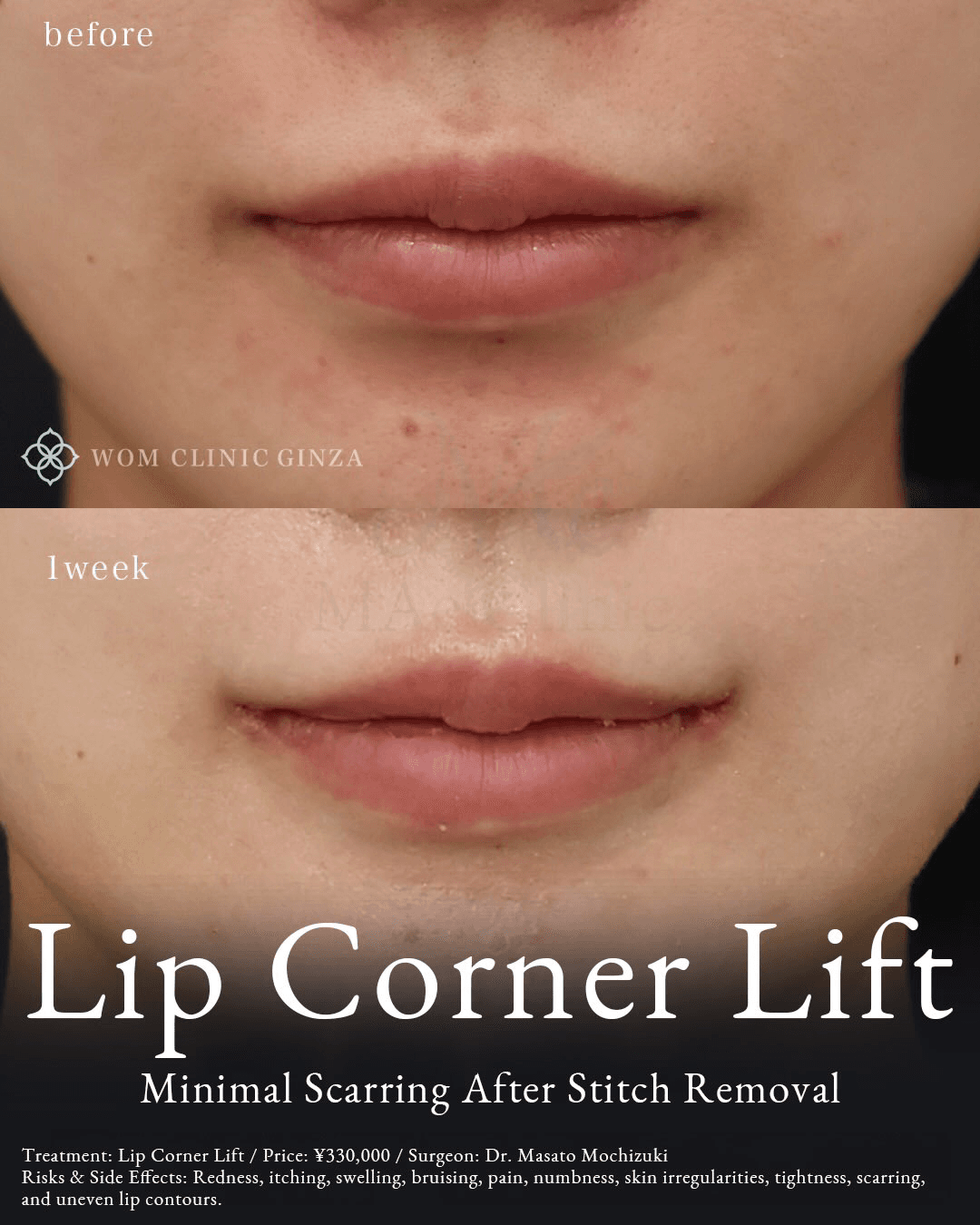
Choosing a Corner Lip Lift Technique: Scarring, the Lateral Philtrum, and Mouth Corner Shape
“I'd like a corner lip lift, but I'm worried the scars might be noticeable.”
This is one of the most common concerns patients raise during a corner lip lift consultation.
A corner lip lift raises the corners of the mouth when they appear downturned, with the aim of creating a brighter, natural-looking expression.
Several techniques are available for a corner lip lift. Two commonly used approaches are listed below.
- External Technique
- Full-Thickness Technique
The two techniques differ in where the incisions are made, where the scars are located, and the results they can achieve.
What Is the External Technique?
Several variations of the external technique have been described, including the Perkins and Jeong techniques.
In the external technique, skin is removed from the outer part of the upper lip to the area around the corner of the mouth, allowing the corner itself to be repositioned upward.
In the Perkins technique, the incision is planned from the corner of the mouth along the vermilion border of the upper lip. Skin just outside the corner is removed to lift it.
In the Jeong technique, the incision extends from the upper lip's vermilion border to just outside the corner of the mouth. The corner is then repositioned upward after skin and subcutaneous tissue are removed.
Benefits of the External Technique
A key benefit of the external technique is that it can lift the corners of the mouth while removing excess skin between the outer part of the upper lip and the corners of the mouth.
This technique can address several concerns in a single procedure:
- Lift downturned mouth corners
- Reduce sagging along the outer upper lip
- Make the lateral philtrum appear shorter
It can be particularly beneficial for people with excess skin both around the mouth corners and above the outer part of the upper lip due to aging or other factors.
Scarring After the External Technique
Scarring is the main concern with the external technique.
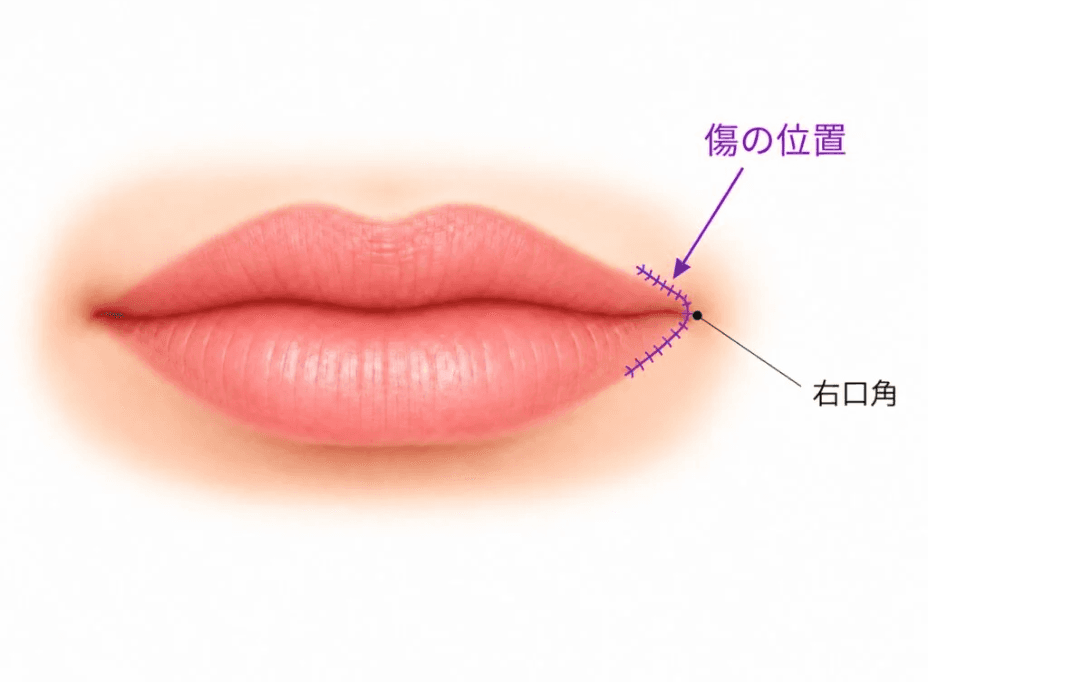
Because the incision extends into the surrounding skin, the scar extends beyond the vermilion border, where the red part of the lip meets the skin. The scar also crosses the corner of the mouth and can be noticeable depending on how the individual heals, how the incision is designed, and how it is closed.
Perkins reported that a drawback of the external technique is a permanent scar approximately 1–1.5 cm long just outside the corner of the mouth.
In many cases, the scar gradually becomes less noticeable, and redness is reported to fade around 2–3 months after surgery.
Jeong and colleagues also published a report on 498 cases.
The report documented the following rates:
• Hypertrophic (raised) scarring: 4.6%
• Depressed scarring: 0.6%
Approximately 3.4% of all cases ultimately required revision surgery because of scarring.
The external technique is highly effective at lifting the corners of the mouth, and the possibility of a visible scar is an important consideration.
The area around the corners of the mouth moves frequently during everyday activities such as talking, eating, and smiling.
Excessive tension on the incision can cause the scar to widen, create tightness at the corner of the mouth, or lead to a web-like scar.
Careful surgical planning is therefore important, including where the scar will lie, how tension on the incision will be reduced, and how the incision will be closed.
Scar Location After a Corner Lip Lift (External Technique)
What Is the Full-Thickness Technique?
The full-thickness technique lifts the corner of the mouth by making an incision through all tissue layers at the corner, from the skin to the oral mucosa, and advancing the inner lining of the mouth outward.
Compared with the external technique, the full-thickness technique preserves more of the skin just outside the corner of the mouth.
Benefits of the Full-Thickness Technique
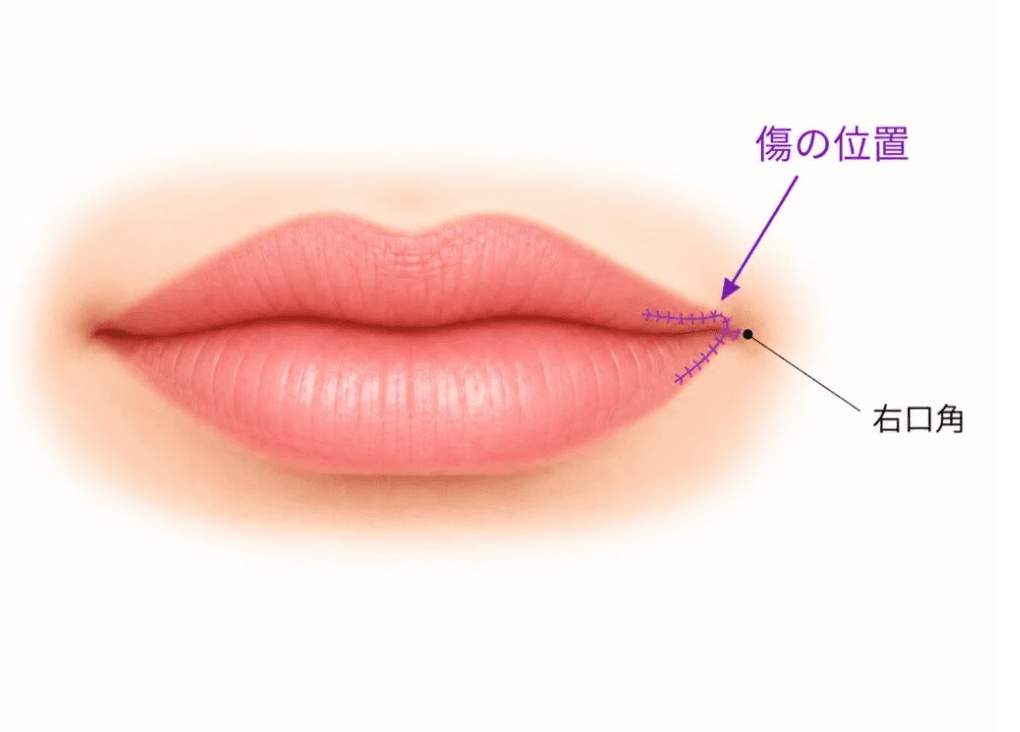
A key benefit is that the scar is easier to conceal within the red part of the lip or just inside the corner of the mouth.
This allows the corners of the mouth to be lifted while avoiding the long skin scars that can extend outward from the mouth corners with the external technique.
Because the skin is closed without sutures crossing the corner of the mouth, this technique is less likely to produce the web-like scar that can sometimes develop with the external technique.
Adjusting the incision horizontally can also widen the lips while lifting the corners of the mouth.
This technique can be particularly effective for patients who want a natural-looking lift with scars that are as discreet as possible.
Scar Location After a Corner Lip Lift (Full-Thickness Technique)
Limitations of the Full-Thickness Technique
The full-thickness technique leaves the skin above the outer upper lip intact. Its effect is limited to lifting the corners of the mouth when the lateral philtrum is long or the skin above the outer upper lip is loose.
In these cases, a full-thickness corner lip lift may be combined with lateral philtrum shortening. The most suitable approach depends on which of the following goals you want to achieve.
- Lift the corners of the mouth
- Shorten the lateral philtrum as well
- Remove loose skin above the outer upper lip as well
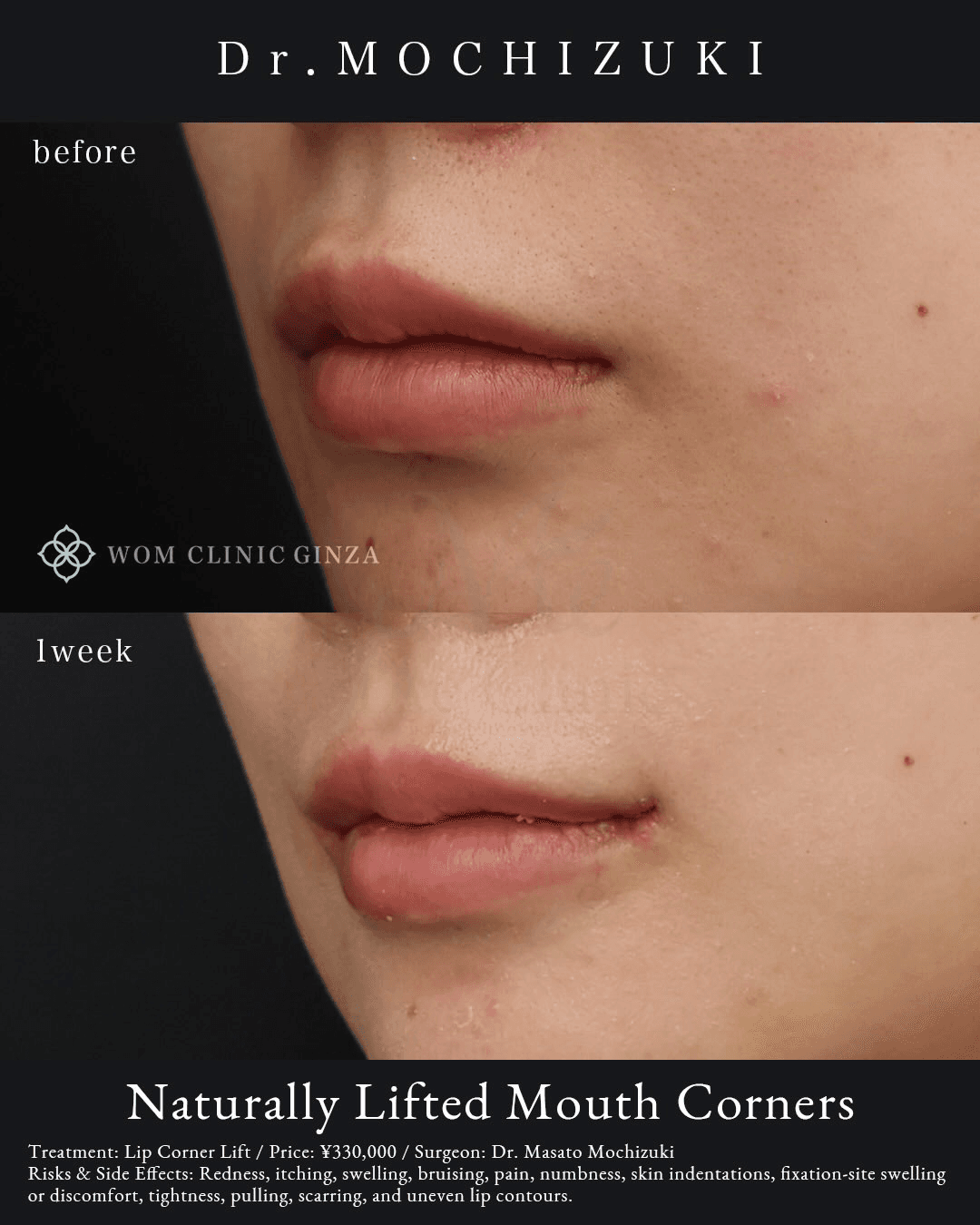
This Case: Corner Lip Lift Using the Full-Thickness Technique
This patient underwent a corner lip lift using the full-thickness technique.
At one week after surgery, the scars were barely noticeable because there were no long incisions on the skin surface.
The corners of the mouth were carefully repositioned and reshaped to create a natural-looking lift.
In a corner lip lift, both the degree of lift and the placement of the incisions are important.
Corner Lip Lift Before and After Photos (1 Week Post-Op)
External vs. Full-Thickness Technique: Which Is Right for You?
The best technique depends on your anatomy and what you want to achieve.
The external technique may be a good option if you want to:
- Lift the corners of your mouth
- Remove loose skin above the outer part of your upper lip
- Shorten the lateral philtrum
The full-thickness technique may be a good option if you want to:
- Keep visible skin scarring to a minimum
- Achieve a natural-looking lift at the corners of your mouth
- Adjust the width of your lips
When choosing a technique, I believe it is important to assess the overall balance of the mouth, including the central and lateral philtrum, the shape of the upper lip, the position of the mouth corners, and the width of the lips.
To achieve a natural, balanced result, I tailor the surgical approach to each patient and combine procedures when needed.
References
1. Perkins SW. The Corner of the Mouth Lift and Management of the Oral Commissure Grooves. Facial Plast Surg Clin North Am. 2007;15:471–476.
2. Jeong TK. Surgical Method of a Corner Mouth Lift. Plast Reconstr Surg Glob Open. 2020;8. doi:10.1097/GOX.0000000000002653.