Told You Need Transcutaneous Blepharoplasty Because of Your Age? | What Guides the Choice Between Transconjunctival and Transcutaneous Blepharoplasty
Under-Eye Dark Circle Treatment/Midface Lift/Transconjunctival Blepharoplasty
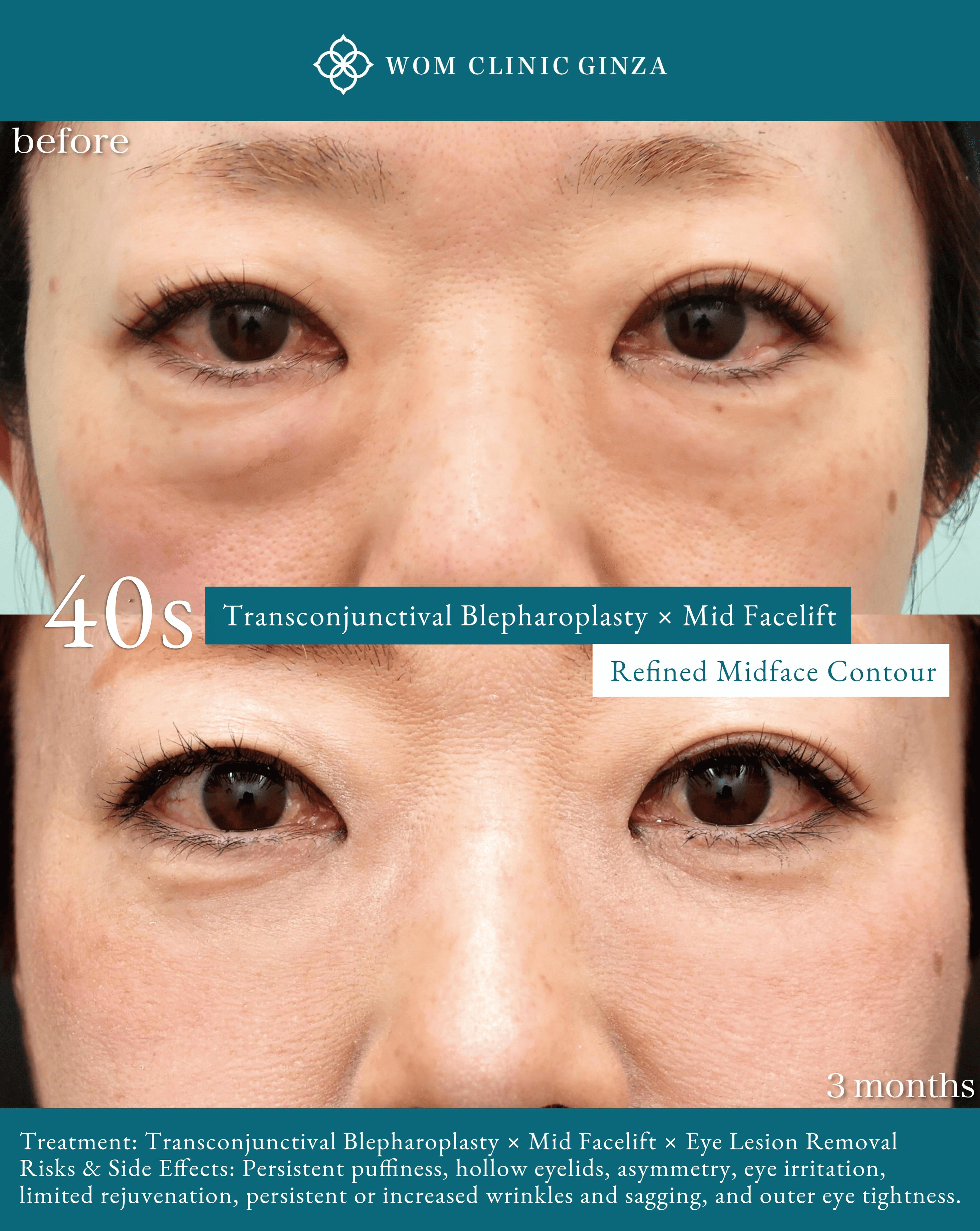
For those told they need transcutaneous rather than transconjunctival blepharoplasty because of their age
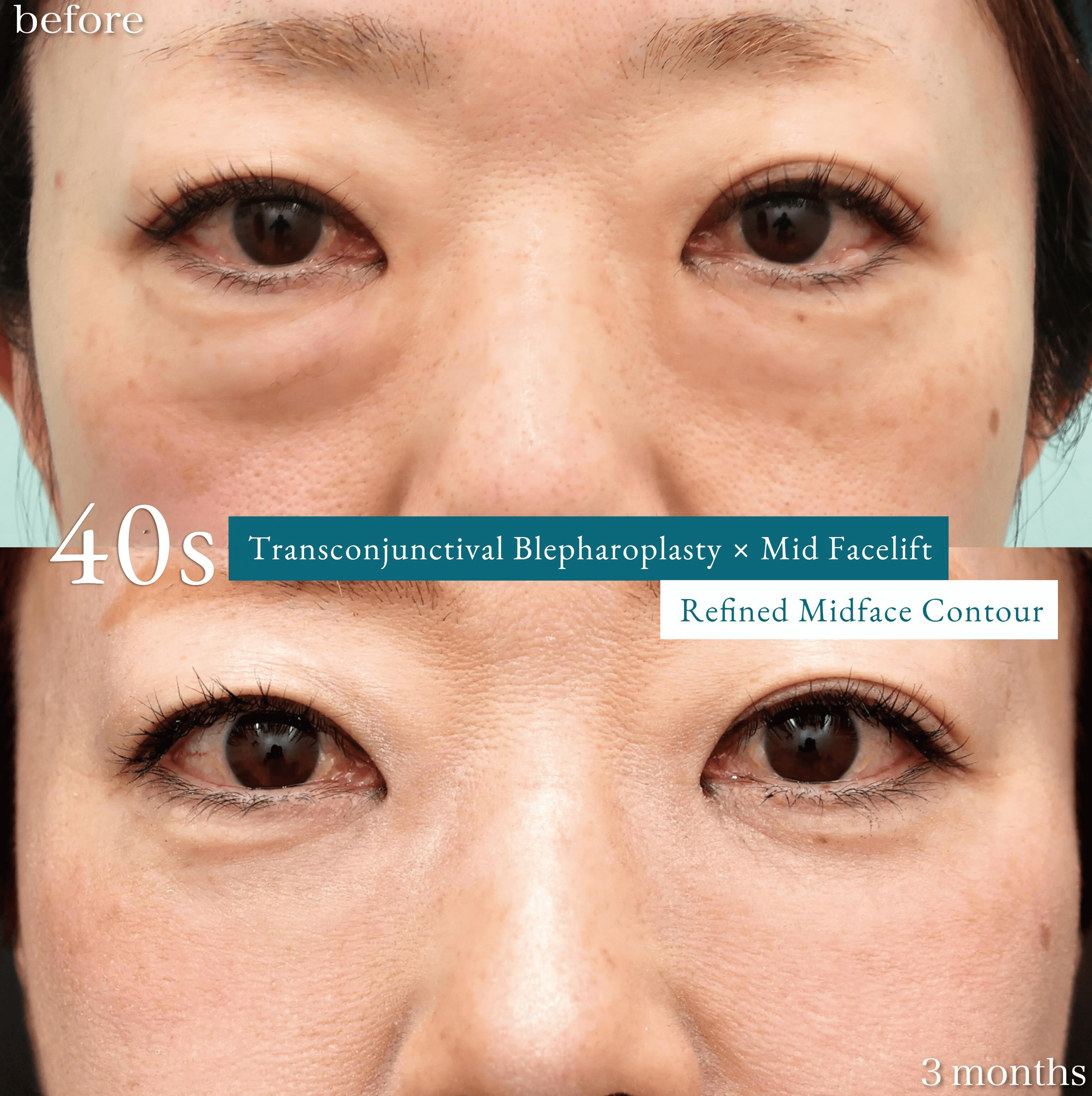
During consultations, I sometimes hear patients say, “At another clinic, I was told that because of my age, transcutaneous blepharoplasty would be a better option for me than transconjunctival blepharoplasty.”
It’s true that as we age, the skin of the lower eyelids tends to lose elasticity, and wrinkles and excess skin become more noticeable.
So I understand why the transcutaneous blepharoplasty, which involves an incision through the skin, is chosen more often for older patients.
Still, I’ve long wondered whether age alone is enough to decide between the transconjunctival and transcutaneous approaches.
Ultimately, I give more weight to the current condition of each patient’s under-eye area than to their age.
What’s the difference between Transconjunctival Blepharoplasty and Transcutaneous Blepharoplasty?
Both Transconjunctival Blepharoplasty and Transcutaneous Blepharoplasty use orbital fat to smooth out bulges and hollows under the eyes.
One of the main differences is where the incision is made.
In Transconjunctival Blepharoplasty, the incision is made through the conjunctiva, the tissue lining the inside of the lower eyelid. This approach generally leaves no incision line on the skin.
In Transcutaneous Blepharoplasty, the incision is made in the skin near the lower lash line.
This approach gives the surgeon direct access to the skin and the orbicularis oculi muscle, so Transcutaneous Blepharoplasty may be suitable for patients with significant excess skin under the eyes.
Neither procedure is inherently better. What matters is which approach best suits the individual patient.
Do your 40s automatically call for Transcutaneous Blepharoplasty or your 50s for a skin incision?
Age alone can’t tell us how someone is aging.
Even among people in their late 40s, we see a wide range of under-eye skin characteristics:
- Skin that still has good firmness
- Thin skin that wrinkles easily
- Little to no excess skin
- Under-eye skin that has stretched considerably
These differences can make the under-eye area look and feel very different from one person to the next.
Many people also keep up with aesthetic treatments and skincare, so the condition of their skin doesn’t always reflect their chronological age.
That’s why we need to examine each patient’s under-eye tissues in person before deciding whether Transcutaneous Blepharoplasty is appropriate. An age cutoff alone can’t make that decision.
What I assess when choosing between Transcutaneous Blepharoplasty and Transconjunctival Blepharoplasty
During the consultation, I assess several factors in addition to the patient’s age.
I pay particular attention to the following:
- Skin firmness
- Skin thickness
- The amount of excess skin
- Under-eye wrinkles
- How much the orbital fat has stretched the skin
- How far the orbital fat protrudes
- The appearance of the natural roll just below the lower lashes
- Under-eye hollows
- The position of the cheeks
- The bone structure of the midface
These are some of the main factors I consider.
I weigh these findings together to determine whether Transconjunctival Blepharoplasty or Transcutaneous Blepharoplasty is better suited to the patient.
Skin that looks loose may not need to be removed
This is another important point to consider.
A prominent under-eye bulge can push the skin forward and make it look stretched.
Based on that appearance alone, it may seem that there is excess skin that should be removed.
In some cases, smoothing out under-eye bulges and hollows can change the way the skin looks.
When deciding whether skin removal is needed, it’s important to consider the three-dimensional contours of the under-eye area along with the patient’s age and the number of wrinkles visible before surgery.
Transcutaneous Blepharoplasty is the right choice for some patients
I recommend Transconjunctival Blepharoplasty when it suits the individual patient.
Transcutaneous Blepharoplasty may be more suitable when there is significant excess skin or when both the skin and the orbicularis oculi muscle need to be adjusted.
The principle I follow is simple.
Examine the patient first, then use those findings to choose between Transconjunctival Blepharoplasty and Transcutaneous Blepharoplasty.
That’s how I make the decision.
Transconjunctival Blepharoplasty and Transcutaneous Blepharoplasty each have their own benefits and indications.
That’s why it’s important to understand both procedures before choosing one.
Transconjunctival Blepharoplasty can be suitable for some patients in their 40s and 50s
In my practice, I sometimes find that Transconjunctival Blepharoplasty is suitable for patients in their late 40s or in their 50s.
This is especially true for patients whose lower eyelid skin is still in relatively good condition.
In these cases, skin removal may be unnecessary.
By smoothing out under-eye bulges and hollows through an incision in the conjunctiva, Transconjunctival Blepharoplasty can help achieve a natural-looking improvement without an incision on the skin.
Pronounced under-eye bags call for a look at the whole face
This patient had fairly pronounced under-eye bags. In cases like this, treating the under-eye area alone may do little to make the face as a whole look younger.
One reason is midface descent. As the cheeks shift downward with age, the following features can become more noticeable:
- Under-eye hollows
- Midcheek grooves
- Flattening of the cheeks
- Nasolabial folds
These changes can become apparent together from the lower eyelids down through the midface.
For this patient, I combined Transconjunctival Blepharoplasty with a midface lift.
Combining Transconjunctival Blepharoplasty with a midface lift
Transconjunctival Blepharoplasty smooths out bulges and hollows under the eyes.
A midface lift raises the descended cheek tissues to a more appropriate position. The goal of combining the two procedures is to create a smoother, more continuous contour from the lower eyelids to the cheeks.
As in this case, the combination may be an option for patients with under-eye bags, prominent midcheek grooves, and significant cheek descent.
Before considering whether to fill the hollows with fat or hyaluronic acid, it’s important to assess the position of the cheek tissues themselves.
The goal is a natural ogee curve
When a youthful face is viewed from the side or at an angle, the area from beneath the eyes to the cheeks has a natural, three-dimensional S-shaped contour.
This contour is commonly called the ogee curve.
When treating under-eye bags, I pay particular attention to how the under-eye area flows into the cheeks.
Reduce under-eye bulges, soften the hollows, and create a natural transition to the high point of the cheek.
By treating the under-eye area and cheeks as one continuous contour, I aim to create a natural ogee curve that suits each patient’s facial features.
Case study | Patient in their late 40s: Transconjunctival Blepharoplasty and a midface lift
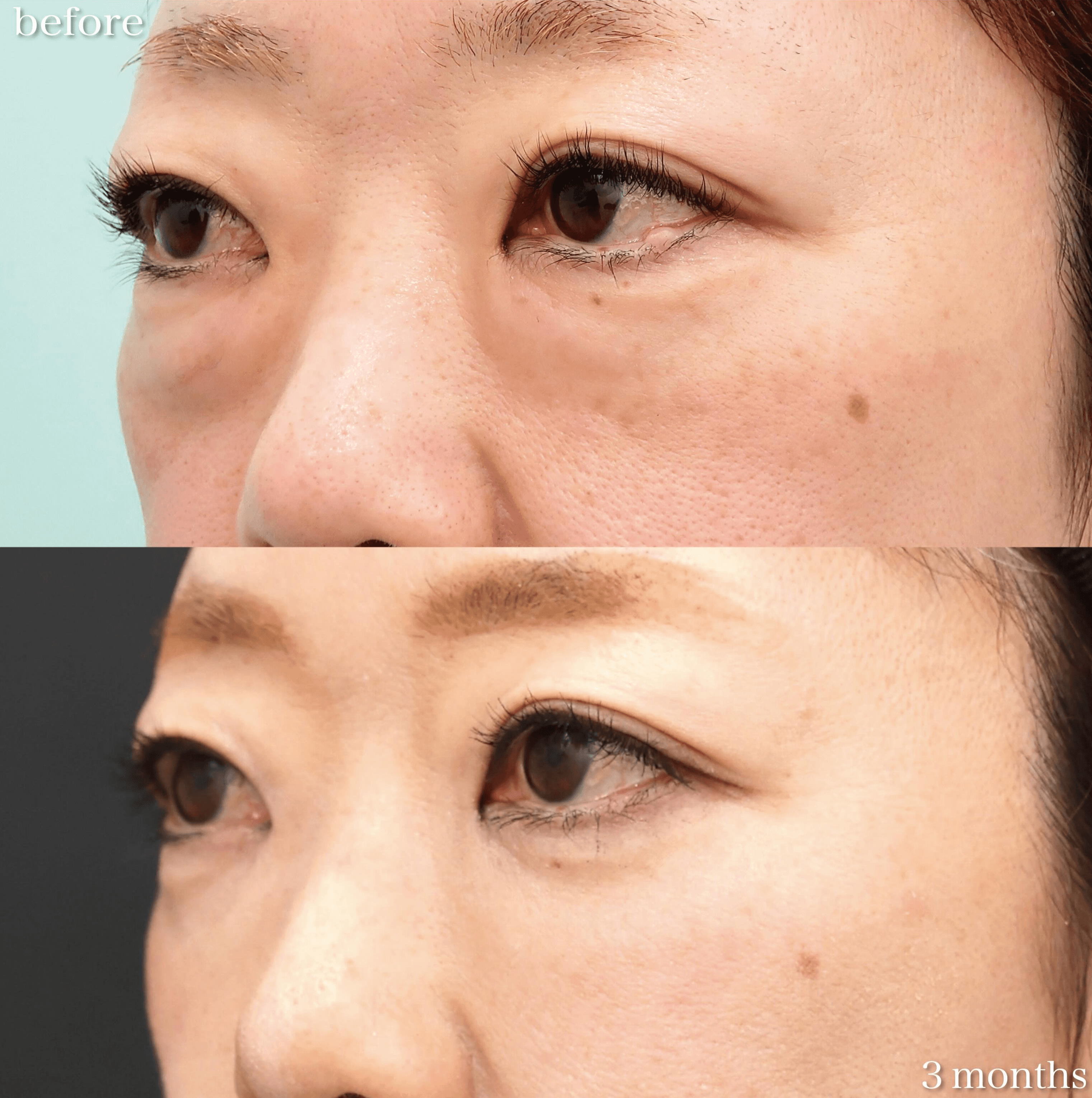
Procedures performed
- Transconjunctival Blepharoplasty
- Midface lift
- Removal of a lesion near the eye
Before surgery, the patient had pronounced bulges and hollows under the eyes. There was also a noticeable change in contour from the midcheek grooves to the cheeks.
In this case, I assessed the under-eye area before choosing Transconjunctival Blepharoplasty. The patient’s age alone did not warrant Transcutaneous Blepharoplasty.
I also performed a midface lift to reposition the cheeks. At the 3-month follow-up, I observed the following changes:
- Less prominent under-eye bags
- Smoother under-eye contours
- Less prominent midcheek grooves
- A higher cheek position
- A natural ogee curve
- A brighter, more youthful overall appearance
These changes were visible at the 3-month follow-up.
I also removed a lesion near the eye that had been bothering the patient. The smoother transition from the lower eyelids to the cheeks helped give the face a naturally more youthful appearance.
Accurate diagnosis guides treatment in complex under-eye cases
Options for treating under-eye bags include Transconjunctival Blepharoplasty, Transcutaneous Blepharoplasty, orbital fat removal, fat grafting, and a midface lift.
The choice of procedure starts with the patient’s anatomy.
Identify exactly why the patient’s under-eye bags are prominent, then choose a treatment that addresses the cause.
In older patients especially, I look closely at the following possibilities.
- Whether orbital fat alone accounts for the appearance
- Whether there is significant excess skin
- Whether midface descent contributes
- Whether several factors are involved
Determining which factors are present helps guide the treatment choice.
In my view, the more complex the case, the more the outcome depends on the quality of the preoperative assessment as well as surgical skill.
Summary | Choosing between Transconjunctival Blepharoplasty and Transcutaneous Blepharoplasty based on clinical findings
“You’re in your 40s, so you need Transcutaneous Blepharoplasty.”
“You’re in your 50s, so you need a skin incision.”
I don’t think age alone should determine the choice of procedure. I look at several factors together.
- Skin firmness and thickness
- The amount of excess skin
- The extent of wrinkling
- How much the skin has stretched
- The condition of the orbital fat
- The degree of midface descent
- The cheekbones and overall facial bone structure
I consider these findings together to determine which procedure is appropriate.
Transcutaneous Blepharoplasty is appropriate for some patients. Transconjunctival Blepharoplasty may be the better option for others, including some patients in their 40s and 50s.
Choose the procedure based on what the examination shows is appropriate for each patient.
I assess both the under-eye area and the midface to choose the approach most likely to produce a natural-looking result for that patient.
I believe this approach is especially important for achieving a natural-looking improvement in complex cases of under-eye bags.