Can You Assess Transconjunctival Blepharoplasty Results from a Photo Taken While Looking Up? Key Points for Evaluating Natural-Looking Under-Eye Rejuvenation
Under-Eye Dark Circle Treatment / Transconjunctival Blepharoplasty
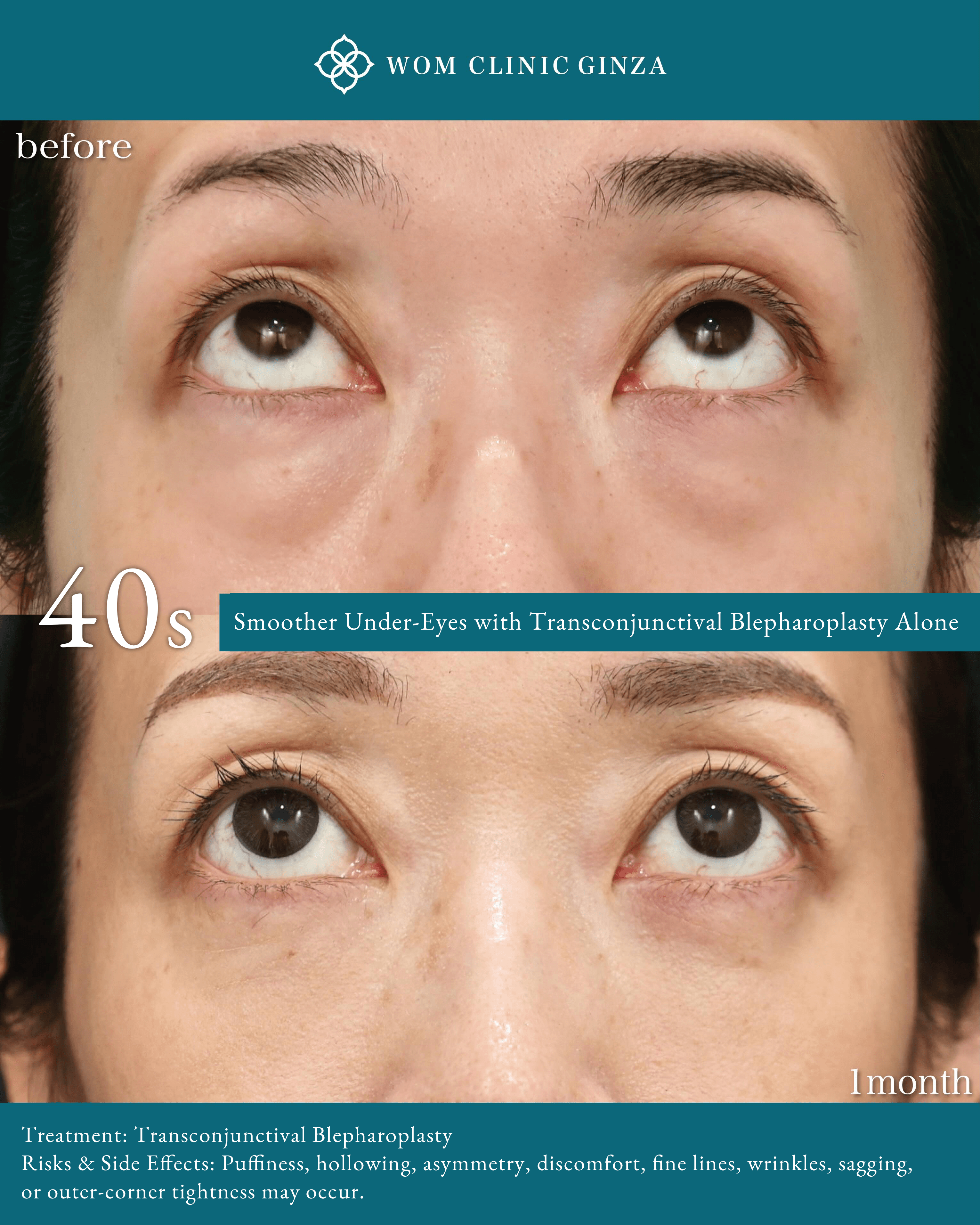
A Good Frontal View Alone Is Not Enough for Transconjunctival Blepharoplasty
When looking at case photos of Transconjunctival Blepharoplasty, I believe most people begin by examining the frontal-view photos.
Of course, frontal-view photos are extremely important for assessing factors such as:
- whether the under-eye bags have been eliminated
- whether the tear trough hollows have improved
- whether facial asymmetry has been corrected
However, when I evaluate the results of Transconjunctival Blepharoplasty, I never make a judgment based solely on the frontal view.
This is because the face is a three-dimensional structure and, in everyday life, it is not always viewed from the same angle.
From the front, at an angle, from the side, while smiling, and while looking upward.
I believe that a high-quality result requires the face to look natural under as many different conditions as possible.
Can Looking-Up Photos Reveal the Results of Transconjunctival Blepharoplasty?
In short, a looking-up photo alone cannot reveal everything, but it can provide some useful information.
When a person looks upward, the positional relationship between the eyeball, orbital fat, and tissues surrounding the lower eyelid changes slightly compared with the frontal view.
As a result, irregularities or contour differences that are not noticeable from the front may become easier to see when the person looks upward.
The looking-up position therefore provides a useful reference when assessing the results of Transconjunctival Blepharoplasty from multiple perspectives.
What I Check When the Patient Looks Up
When examining a patient looking upward, I do not simply check whether the dark circles have disappeared.
In particular, I assess:
- whether the orbital fat has been repositioned appropriately
- whether the repositioned tissue is stable
- whether adequate tension in the orbital septum has been maintained
- whether there are any unnatural contour irregularities along the lower eyelid
- whether excessive tension is being placed on the conjunctival side
I evaluate all of these factors comprehensively.
Some of these details can be difficult to identify from frontal-view photos alone.
The Frontal View May Look Good, Yet a Bulge Can Appear When Looking Up
After Transconjunctival Blepharoplasty, the under-eye area may look very smooth from the front yet appear to bulge when the patient looks upward.
This change may be more noticeable in patients who originally had significant orbital fat protrusion or slightly prominent eyes.
For this reason, I do not regard Transconjunctival Blepharoplasty as simply moving fat. I approach it as a procedure that addresses the orbital fat, orbital septum, tissue fixation, and continuity with the midface.
How the Orbital Septum Is Managed Is Also Important in Transconjunctival Blepharoplasty
One of the key structures to consider when evaluating the results of Transconjunctival Blepharoplasty is the **orbital septum**.
The orbital septum is one of the structures that supports the orbital fat.
When this support weakens due to aging or anatomical characteristics, the orbital fat protrudes forward and becomes noticeable as under-eye bags.
Transconjunctival Blepharoplasty therefore does not simply remove the protruding fat. Instead, the fat is moved to the appropriate position to smooth out irregularities beneath the eyes.
Depending on the individual case, it may also be important to reconstruct the area while considering the tension and position of the orbital septum.
Repositioning the Fat Is Not the End of the Procedure
Transconjunctival Blepharoplasty is often described as:
"Moving the orbital fat into the hollowed area."
However, the actual procedure is not that simple.
What matters is the overall surgical design:
how far the tissue should be dissected, where the fat should be repositioned, how much tension should be used for fixation, and how it should blend with the surrounding tissues
Even if the fat is repositioned, improper fixation or an imbalance with the surrounding tissues may cause contour irregularities or bulges to become noticeable from certain angles.
That is why, in Transconjunctival Blepharoplasty, I focus not merely on whether the fat has been moved, but on whether the area from beneath the eyes to the cheeks ultimately forms a smooth, natural contour.
The Goal Is a Natural-Looking Eye Area from Every Angle
The purpose of Transconjunctival Blepharoplasty is not merely to eliminate the appearance of dark circles in frontal-view photos.
Even if the eye area looks good from the front, there is still room for improvement if it:
- bulges when looking upward
- has visible contour irregularities when viewed at an angle
- looks unnatural when smiling
The ideal result is:
a natural appearance from the front, at an angle, while looking upward, and while smiling.
Achieving this requires looking beyond the fat alone and performing the procedure with the lower eyelid and cheek treated as a single three-dimensional structure.
Case Study | Woman in Her 40s—Transconjunctival Blepharoplasty
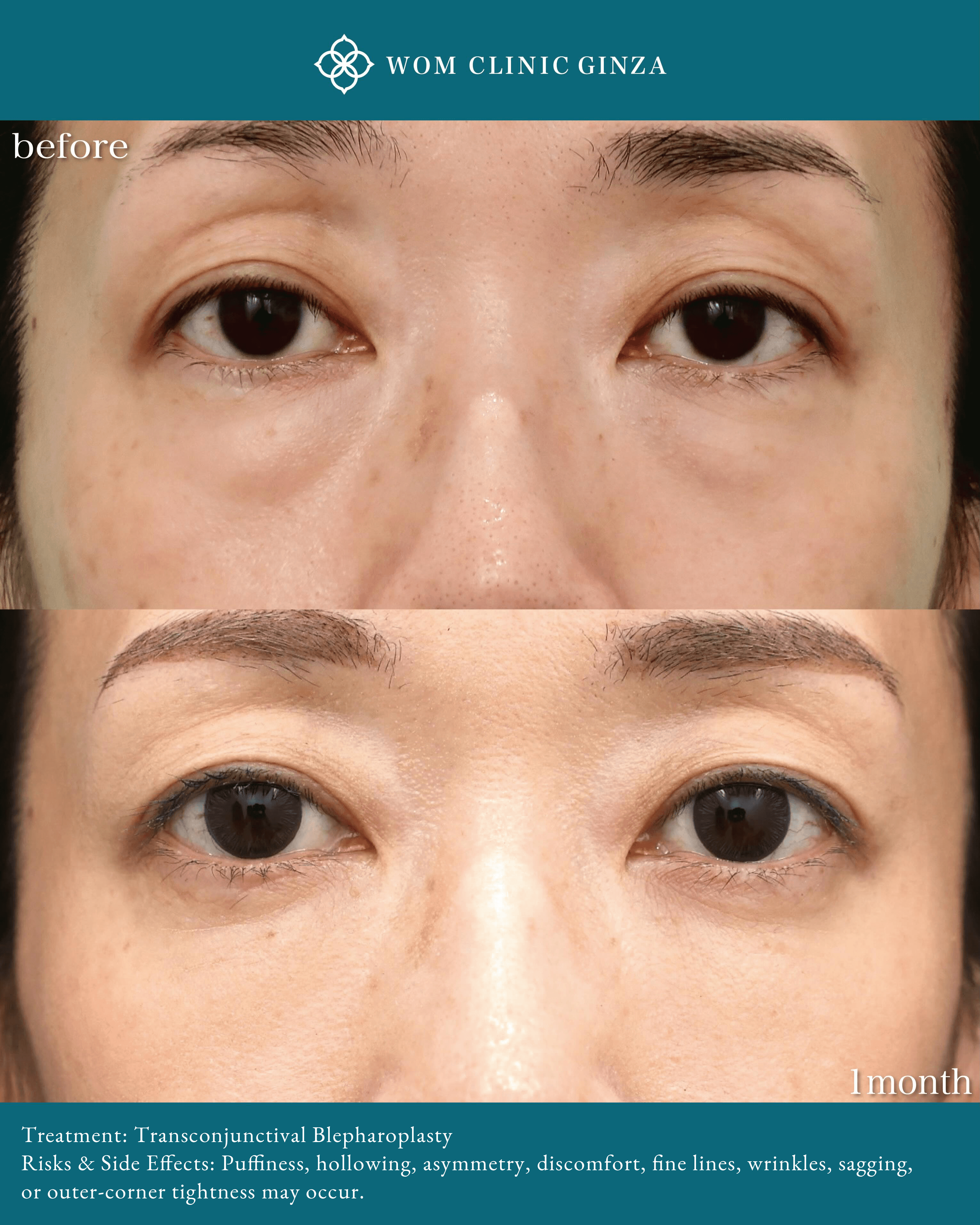
Before surgery, the patient had relatively large under-eye bags. The border between these bulges and the hollows beneath them made her dark circles appear more pronounced.
The orbital fat was appropriately repositioned through Transconjunctival Blepharoplasty to smooth the irregular contours beneath the eyes.
At 1.5 months after surgery, the following changes can be observed:
- significant improvement in the large under-eye bags
- reduced contour irregularities and a smoother profile
- no noticeable unnatural bulging when looking upward
- the patient’s natural under-eye fullness has become slightly more visible
[Transconjunctival Blepharoplasty] Before and 1.5 Months After Surgery
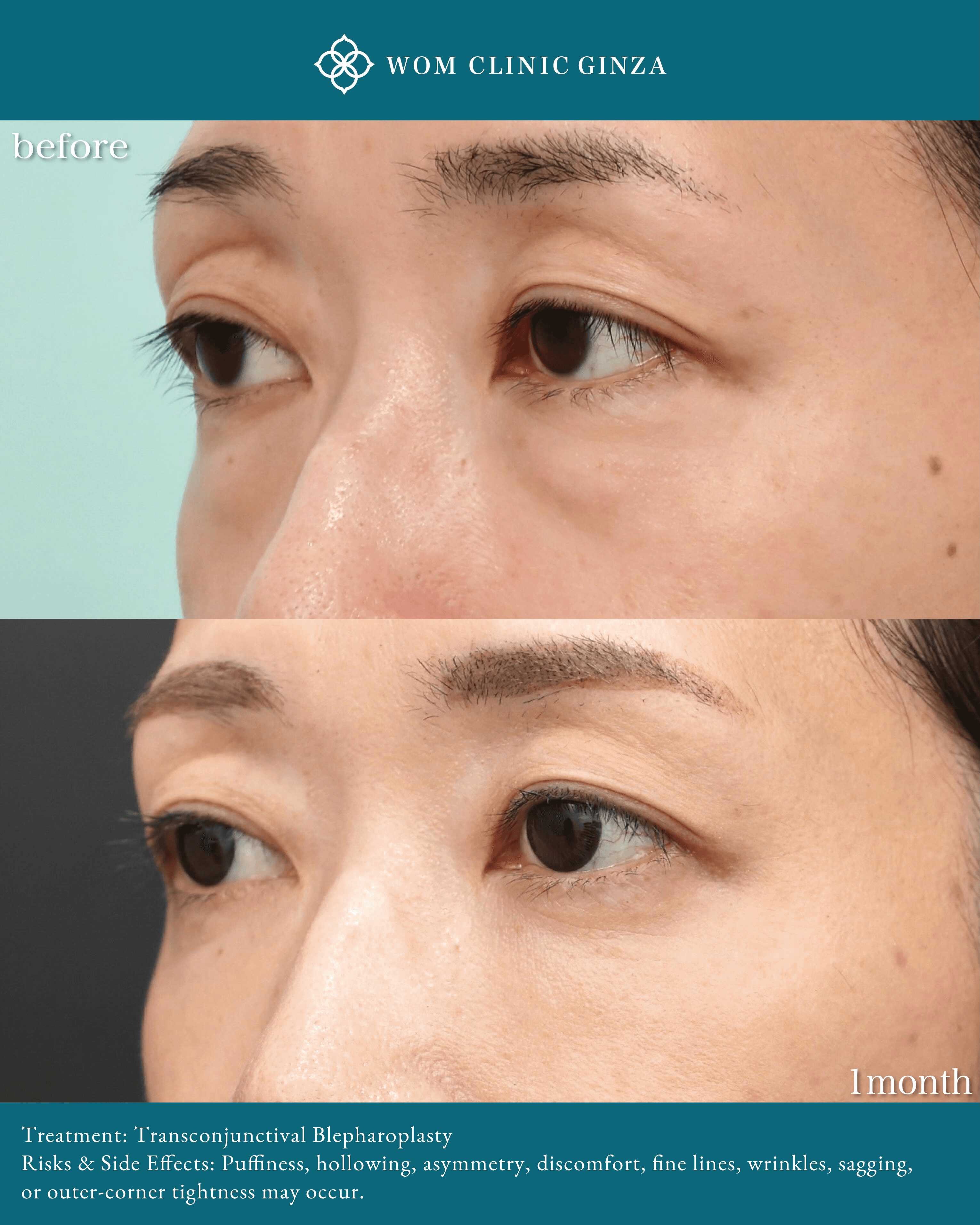
Although it has only been 1.5 months since surgery and the final result has not yet been reached, the eye area already looks natural.
Transconjunctival Blepharoplasty Alone May Make Natural Under-Eye Fullness More Visible
No under-eye fullness enhancement was performed in this case.
Nevertheless, the patient’s natural under-eye fullness has become slightly more visible after surgery.
When under-eye bulging and hollowness are pronounced, the boundary between these areas and the natural fullness beneath the lower eyelid can become less distinct, making the patient’s natural under-eye fullness less noticeable.
When Transconjunctival Blepharoplasty smooths the irregular contours beneath the eyes, the patient’s natural under-eye fullness may become more visible.
However, the extent to which this occurs with Transconjunctival Blepharoplasty alone varies from person to person.
The result also depends on factors such as the shape and volume of the orbicularis oculi muscle, skin thickness, and the degree of eye prominence. If more defined under-eye fullness is desired, an additional enhancement procedure may be performed.
It Is Important to View Case Photos from Different Angles
When viewing cosmetic surgery case photos, it is important not to judge the results solely from frontal before-and-after images.
If possible, review photos taken under various conditions, including:
- front view
- oblique view
- side view
- looking upward
- neutral expression
- smiling
Examining the results under multiple conditions makes it easier to understand the kind of outcome the procedure is intended to achieve.
However, the quality of a surgical result cannot be fully assessed from photographs alone.
The appearance may vary depending on the photography conditions, facial expression, and lighting. It is therefore important to regard photographs as just one of several factors used to evaluate the results.
Summary | The Transconjunctival Blepharoplasty Aims for a Natural Look from Every Angle
The outcome of a Transconjunctival Blepharoplasty should not be evaluated solely from a frontal photograph.
Examining the area while the patient is looking upward may provide useful information about under-eye bulging, contour irregularities, and the shape of the repositioned fat.
The key points I focus on when performing the Transconjunctival Blepharoplasty are:
- Dissection over an appropriate area
- Proper repositioning of the orbital fat
- Stable fixation
- Structural adjustment, including the orbital septum
- A natural, smooth transition from the under-eye area to the cheek
The goal is not merely to look good in frontal photographs, but to appear natural from every angle.
I believe that performing the Transconjunctival Blepharoplasty with this level of consideration leads to a naturally beautiful eye area.