Deep-Set Eyes That Don’t Catch the Light? Addressing the Bone Structure with Endoscopic Brow Lift + Orbital Rim Contouring
Double Eyelid & Eye Surgery/Temporal Fixation/Orbital Rim Contouring/Endoscopic Brow Lift
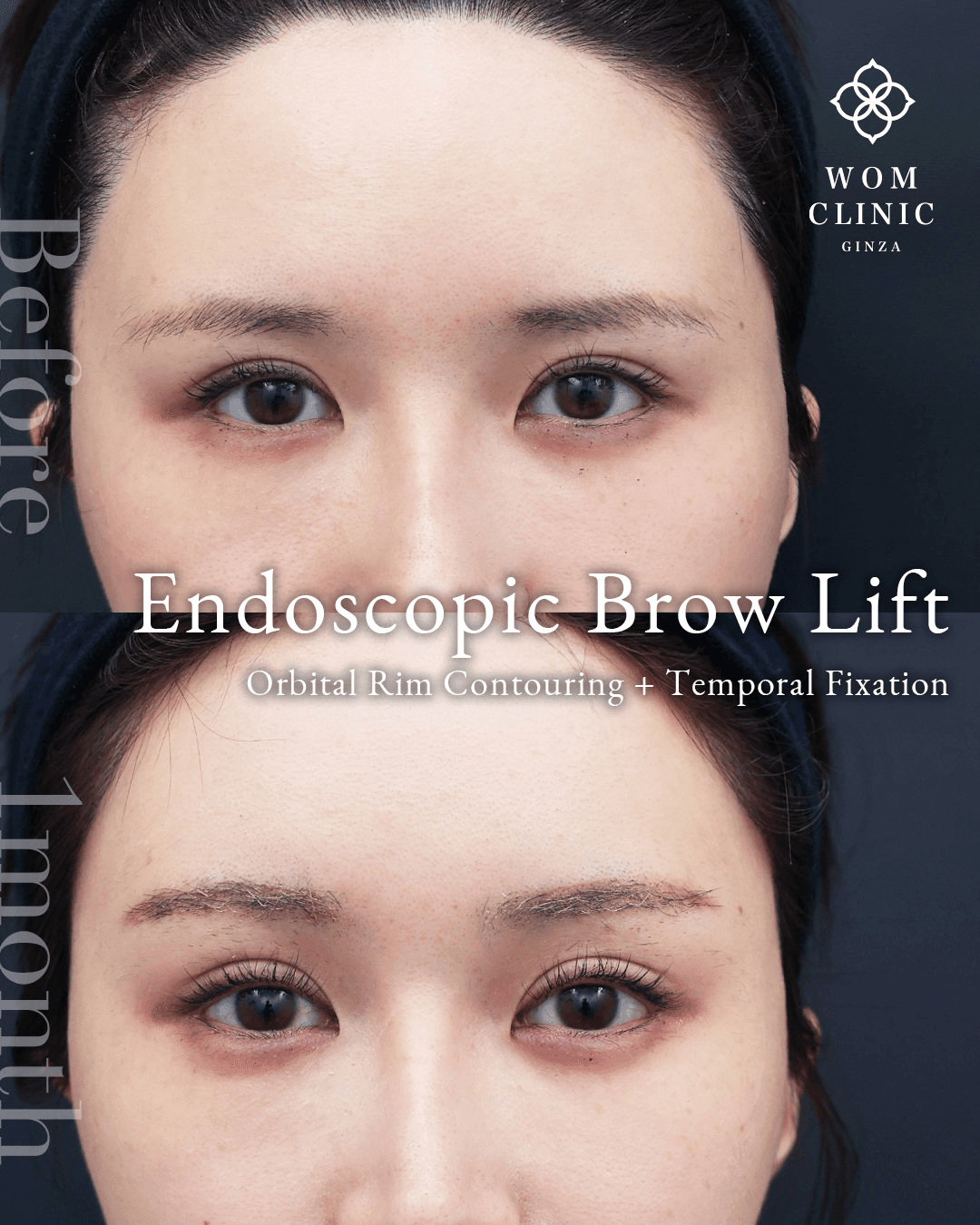
Could Bone Structure Be Why Your Eyes Look Dark? | Enhancing the Eye Area with Endoscopic Brow Lift + Orbital Rim Contouring
“My eyes look dark for some reason.”
“It feels like my eyes don’t catch the light.”
She had visible eyelid creases and her eyes opened well. Even so, her eyes didn’t stand out.
This case features a woman in her twenties who came to us with these concerns.
The width of her eyelid creases wasn’t the cause.
The cause lay in her bone structure and the overall proportions of her upper face.
In this case, we combined Endoscopic Brow Lift, Orbital Rim Contouring, and Temporal Fixation to address those underlying factors and transform the appearance of her eye area.
■ Before Surgery: What Was Causing the Concern?
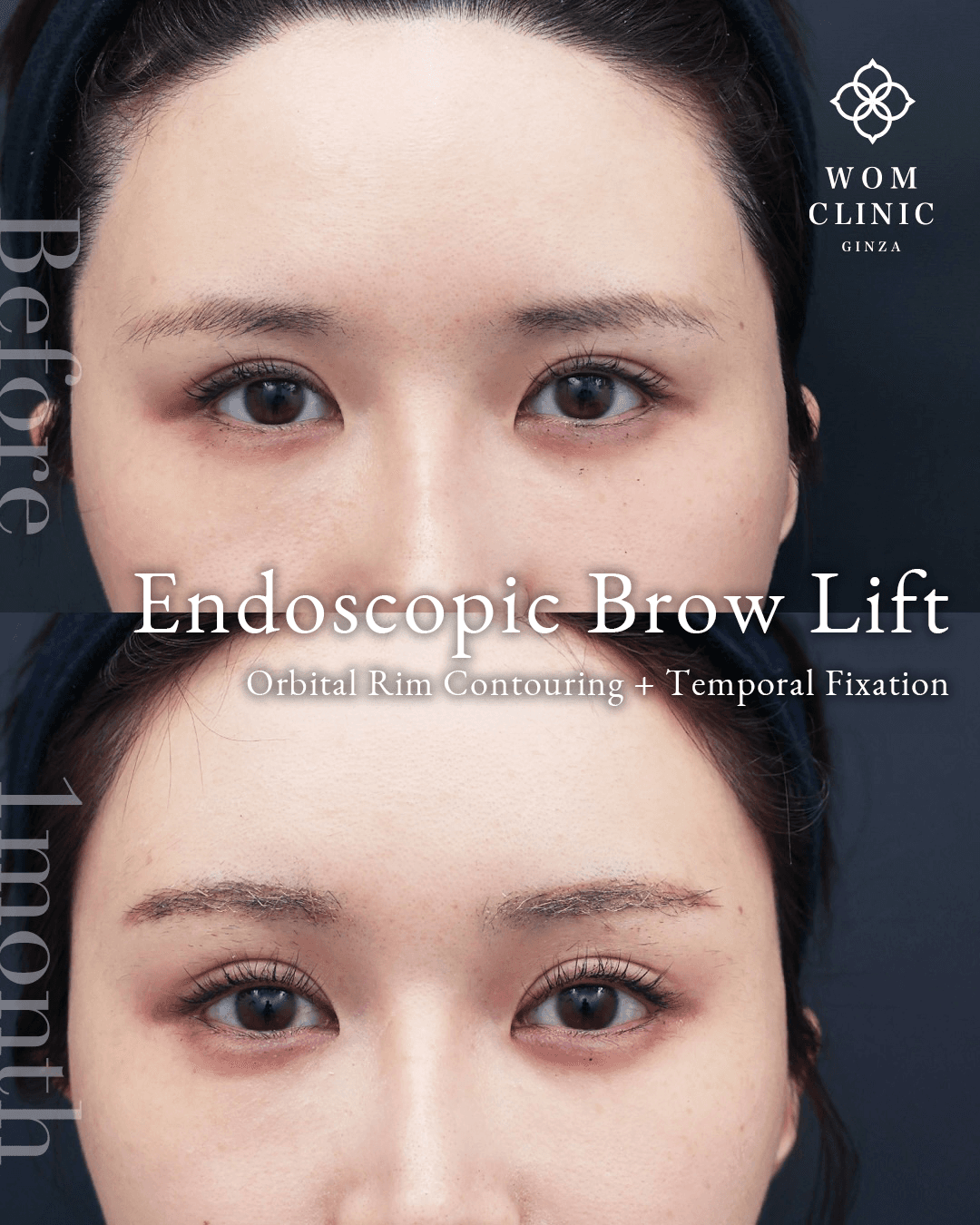
The patient was a woman in her twenties with well-defined upper eyelid creases. Her eyes opened well, but she still had these concerns.
“My eyes don’t catch the light.” “My eyes look dark and deep-set.”
The cause lay in the bone structure around her eyes rather than in her eyelids.
When the superior orbital rim, the bony upper edge of the eye socket, is prominent, it forms an overhang above the eye.
That overhang blocks light from reaching the eye.
In deep-set eyes, the eyeball sits farther back in the socket and can itself fall into shadow.
■ How Do Orbital Rim Contouring and Brow Bone Contouring Differ?
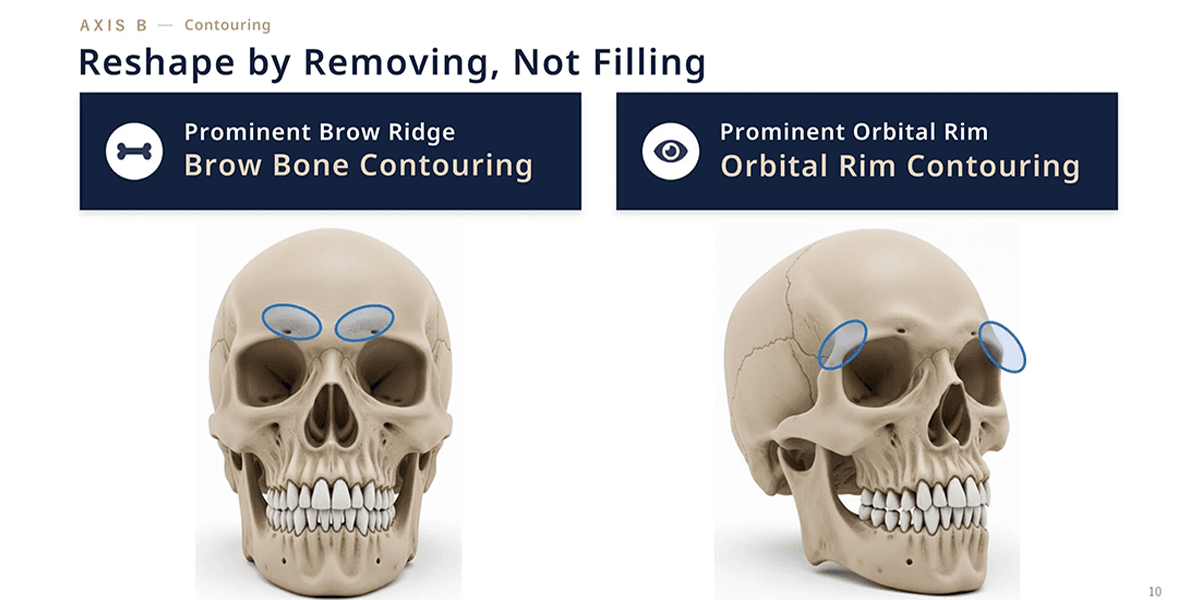
These two procedures are often confused because they involve nearby areas of bone. They target different locations. First, look at the face from a 45-degree angle.
A bony prominence near the outer end of the eyebrow is an indication for Orbital Rim Contouring. This procedure smooths the bony edge of the eye socket.
If a prominence is visible in the contour above the eyebrow when viewed directly from the side, Brow Bone Contouring is often indicated.
In this case, the main cause was a prominent superior orbital rim. The brow bone was left intact.
We carefully reshaped the orbital rim, checking its curvature by palpation from the outside to create a smooth contour.
■ Why Is the Amount of Bone Removal Decided During Surgery? [Before and After Endoscopic Brow Lift + Orbital Rim Contouring + Temporal Fixation]

The exact amount of bone to remove depends on how the tissues shift during the lift.
During an Endoscopic Brow Lift, the retro-orbicularis oculi fat (ROOF) stretches as the surrounding tissues move upward.
This shift changes how prominent the orbital rim appears.
During surgery, we assess the contour with the tissues in their lifted position and adjust how much bone we remove as we go.
This step helps achieve a natural-looking result and prevent overcorrection.
■ Why We Combined Three Procedures
In this case, we performed three procedures in the same operation.
① Endoscopic Brow Lift
We make just four small incisions in the hair-bearing scalp.
Using an endoscope for visualization, we lift the entire forehead at a deep tissue plane.
The lift also stretches the retro-orbicularis oculi fat (ROOF), helping the eyes look less deep-set.
② Orbital Rim Contouring
We smooth the bony upper edge of the eye socket.
This allows more light to reach the eyes.
It also directly reduces the deep-set appearance of the eyes.
③ Temporal Fixation
We secure the lifted tissues in place. This step helps prevent them from shifting back toward their original position.
Together, the three procedures change the appearance of the eye area by reshaping the bone, lifting the soft tissues, and securing them in their new position.
■ Postoperative Changes from the Front

Take a look at the front-view photo taken one month after surgery.
The brows sit higher while maintaining a natural appearance, and there is more space between the eyes and brows.
The eyes now catch more light, giving her a brighter, softer expression.
Her eyes still look well-proportioned, and the shadowed appearance is gone.
■ Changes in the Bony Contour from the Side and Three-Quarter Views

The changes in the bony contour are clear in the side and three-quarter views.
Before surgery, the upper rim of the eye socket projected forward, partially obscuring the eye behind it.
After surgery, the upper orbital rim has a smoother contour. The area around the eye looks flatter, allowing light to reach the eye more easily.
The three-quarter view also shows that the brow sits higher and the upper eyelid crease is more visible.
Reshaping the surrounding bone gives the eyes a more striking appearance while leaving the eyes themselves untouched.
■ Recovery Timeline [Endoscopic Brow Lift + Orbital Rim Contouring + Temporal Fixation]

One week after surgery, some bruising remains, along with redness and swelling around the eyes. These are expected at this stage of recovery and generally no cause for undue concern.
One month after surgery, most of the swelling has subsided, and the change in the appearance of the eye area is clearly visible.
Typical recovery milestones
- Swelling peaks 2–3 days after surgery
- Bruising improves within 1–2 weeks
- The contour settles 1–3 months after surgery
■ Who Might Consider This Surgery?
If any of the following concerns sound familiar, we invite you to schedule a consultation.
- You feel that your eyes don’t catch the light easily
- Your deep-set eyes make the eye area look shadowed
- Your brows sit close to your eyes, giving you a stern expression
- You’ve had double eyelid surgery or another procedure around the eyes, but the change was less noticeable than you’d hoped
- You want to change the appearance of your eye area by addressing the underlying bone structure
■ Potential Risks and Side Effects
Potential risks and side effects include nerve injury, bleeding, hematoma, infection, scarring, asymmetry, overcorrection, hair loss, and headache.
Please contact us if you continue to experience discomfort or unusual sensations.
■ Book a Free Consultation
“My eyes look shadowed.” “I’d like my eyes to look less deep-set.”
If these concerns sound familiar, we invite you to come in for a consultation.
We’ll carefully assess your bone structure, brow position, and the overall proportions of your eye area, then recommend a plan tailored to you.
Our clinic offers free consultations. Please feel free to reach out and talk through your concerns with us.