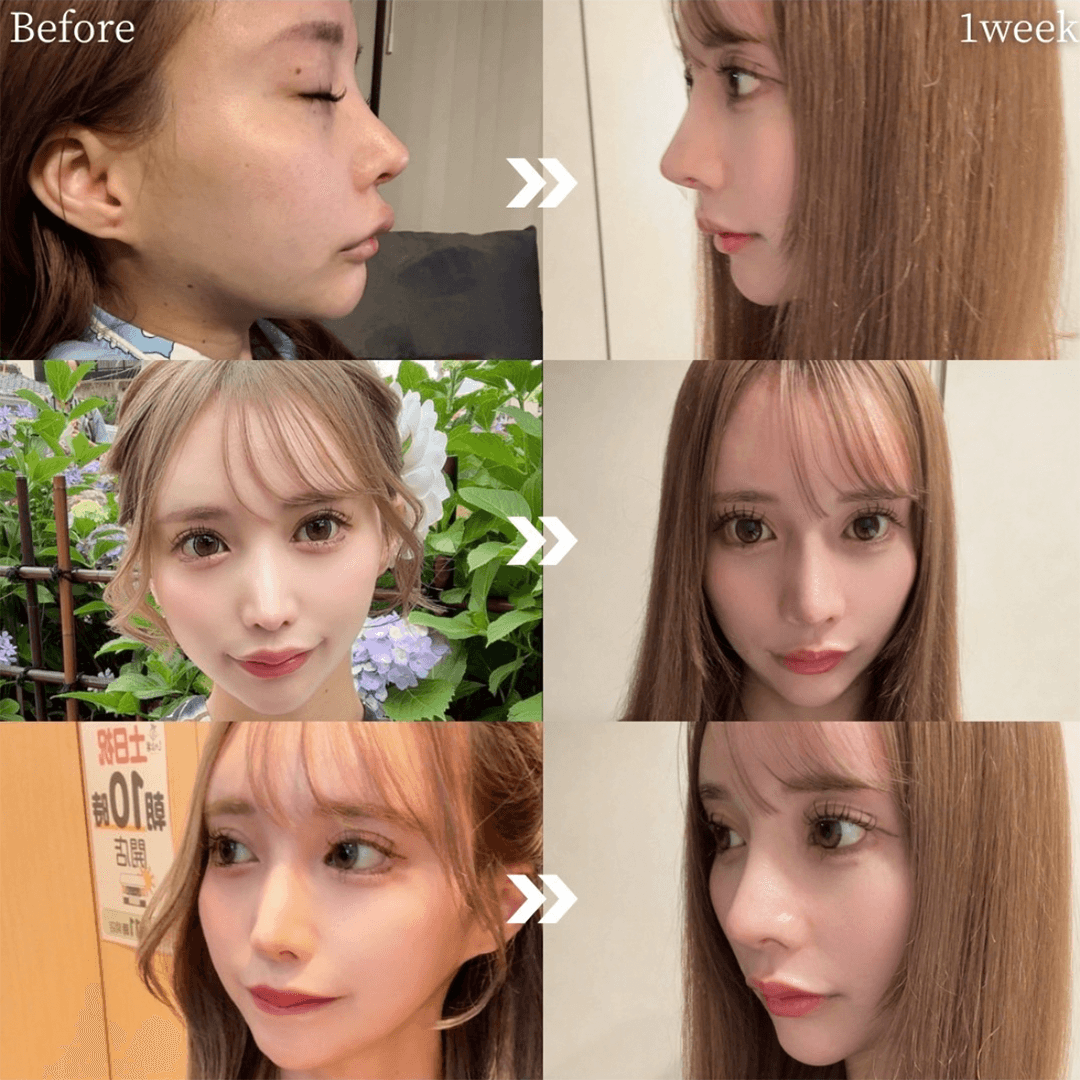
Revision Surgery: Simultaneous Correction of Nostril Asymmetry, Deviation, and Impaired Breathing
Rhinoplasty/Autologous Tissue Rhinoplasty/Costal Cartilage Grafting/Revision Surgery/Septal Extension/Auricular Cartilage Grafting/Tip Plasty
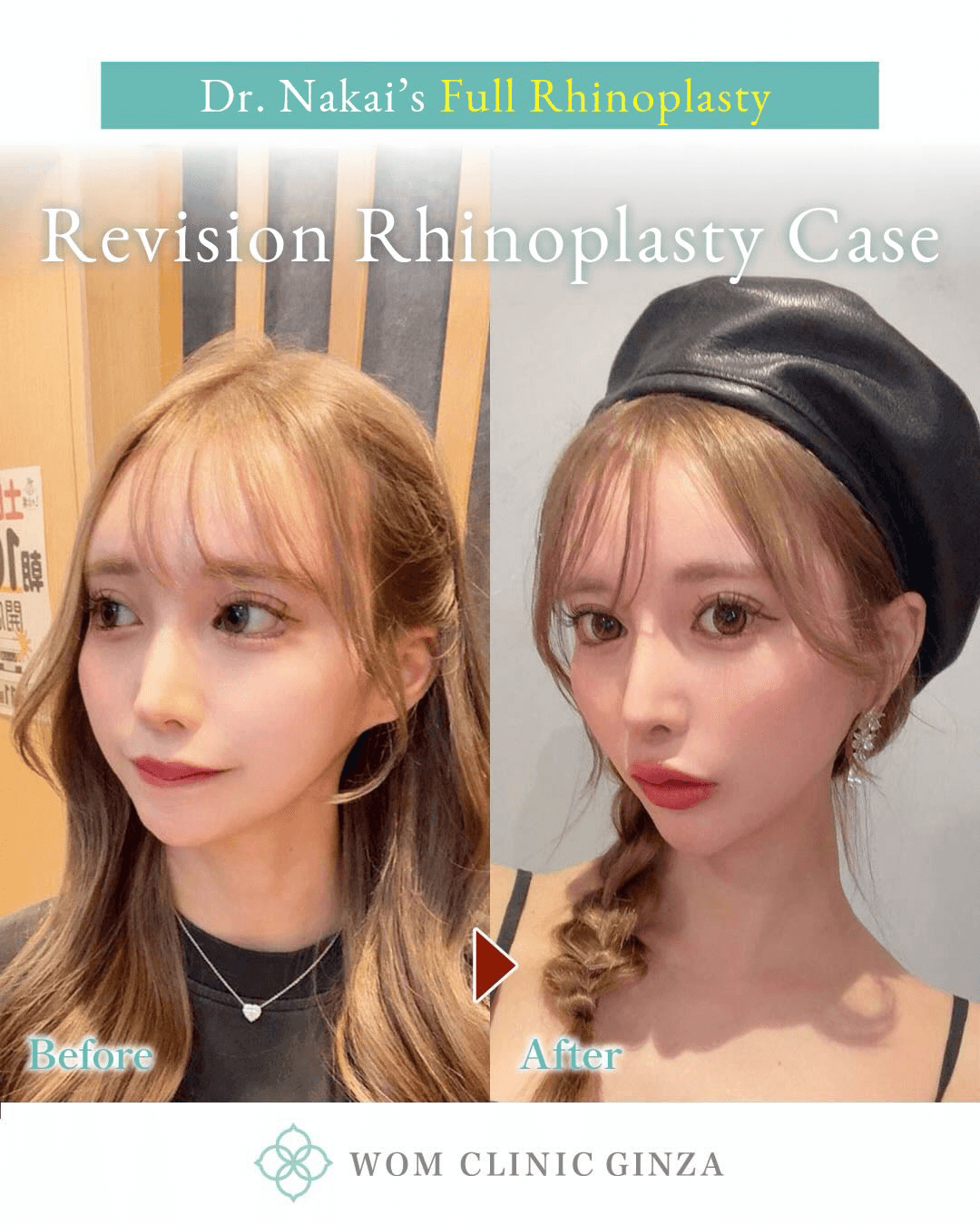
— Advanced Revision Rhinoplasty: Reconstructing a Tilted Nasal Framework with Costal Cartilage to Restore Both Form and Function —
The patient visited our clinic because a previous nasal surgery had resulted in uneven nostrils, an overall crooked appearance of the nose, and impaired nasal breathing.
In rhinoplasty, not only aesthetic appearance but also the functional aspect of breathing is extremely important.
Patients who have undergone multiple previous surgeries often have damaged cartilage or mucosa, as well as a deviated nasal septum. Therefore, both aesthetic and functional restoration are required.
During the examination, we identified:
- Significant deviation of the nasal septum (the central partition of the nose)
- Deformity of the alar cartilage
- Skin adhesions and scarring
- Uneven height of the nostril rims
- Obstruction of one nostril during breathing
These and several other issues were identified.
👃 Causes of Nostril Asymmetry and Nasal Deviation
Various factors can contribute to asymmetry of the nostrils or nasal bridge following rhinoplasty.
▼ Main Causes
- The underlying framework (nasal septum) was originally deviated
- The cartilage was treated unevenly during surgery
- The internal cartilage structures are misaligned
- Tightness and pulling caused by scar contracture
- Postoperative swelling or adhesions caused the cartilage to become distorted and set in an abnormal position
- Weak support along the nostril rim causes one side to droop or rise
The nostrils and nasal bridge are among the facial features in which deviation from the facial midline (center line) is most noticeable.
Therefore, even a slight difference in angle can create an unnatural appearance.
Impaired nasal breathing can also be caused by:
- Deviation of the nasal septum
- Adhesions involving the internal cartilage
- Improper suturing of the medial crura
- Insufficient supporting tissue
These factors also contribute to the problem, meaning that correcting the shape alone will not resolve it.
🔍 The Importance of Preoperative Evaluation
In rhinoplasty, particularly revision surgery, preoperative evaluation is so important that it can be said to determine 70% of the outcome.
Key Points That Must Be Evaluated Before Surgery
- Degree of nasal septal cartilage deviation
- Nasal tip support (cartilage strength and remaining cartilage volume)
- Difference in nostril rim height between the two sides
- Nasal framework (width and height of the nasal bones)
- Skin thickness and firmness
- Scarring and adhesions from previous surgeries
- Airflow during inhalation and exhalation
- Presence of internal structural deformities that obstruct nasal breathing
If surgery is performed without assessing these factors,
the deviation may worsen, the asymmetry may become more pronounced, or nasal breathing may deteriorate further.
In this patient,
- Deviation of the underlying framework
- Deformity of the nasal ala
- Adhesions within the internal structures
- Impaired nasal breathing
were present simultaneously, making structural reconstruction necessary.
✨ Procedures Performed
The patient wished to:
"Achieve a straighter nasal bridge than before"
"Reduce nostril asymmetry as much as possible"
"Improve nasal breathing"
These were the patient’s main requests.
To address these concerns, we performed the following procedures in combination.
▼ Procedures Performed in This Case
- Complex revision rhinoplasty
- Septal extension using costal cartilage
- Tip plasty
- Auricular cartilage grafting
- Autologous tissue augmentation rhinoplasty
By reconstructing the nose entirely with the patient’s own tissue (costal and auricular cartilage),
we achieved strength, flexibility, and long-term stability that are difficult to obtain with artificial materials.
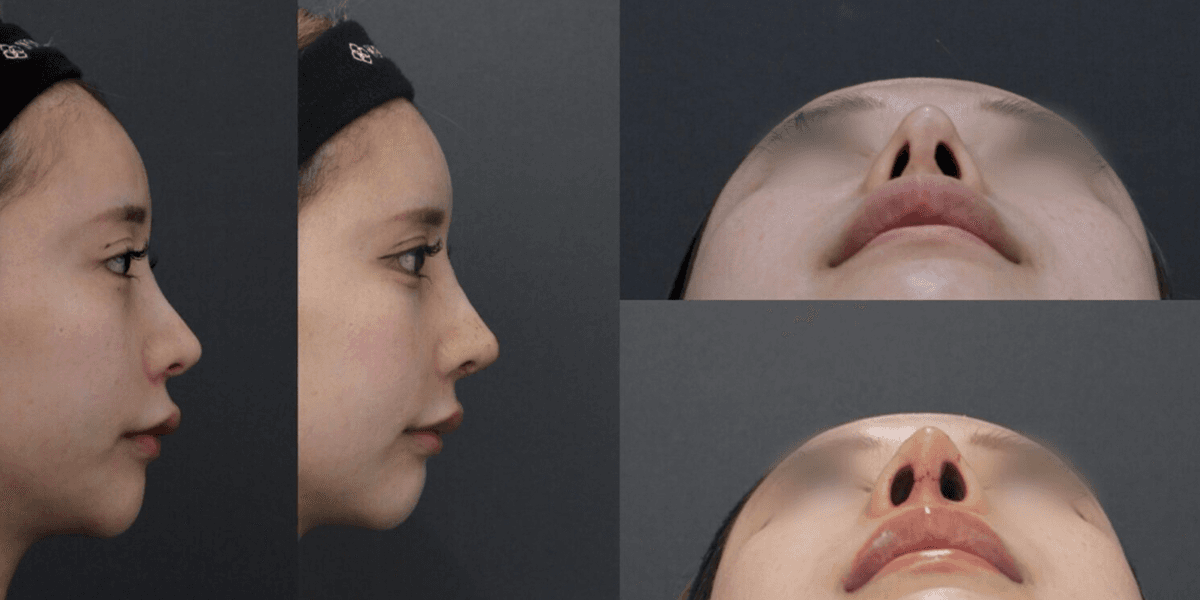
Before and After Complex Revision Rhinoplasty, Septal Extension Using Costal Cartilage, Tip Plasty, Auricular Cartilage Grafting, and Autologous Tissue Augmentation
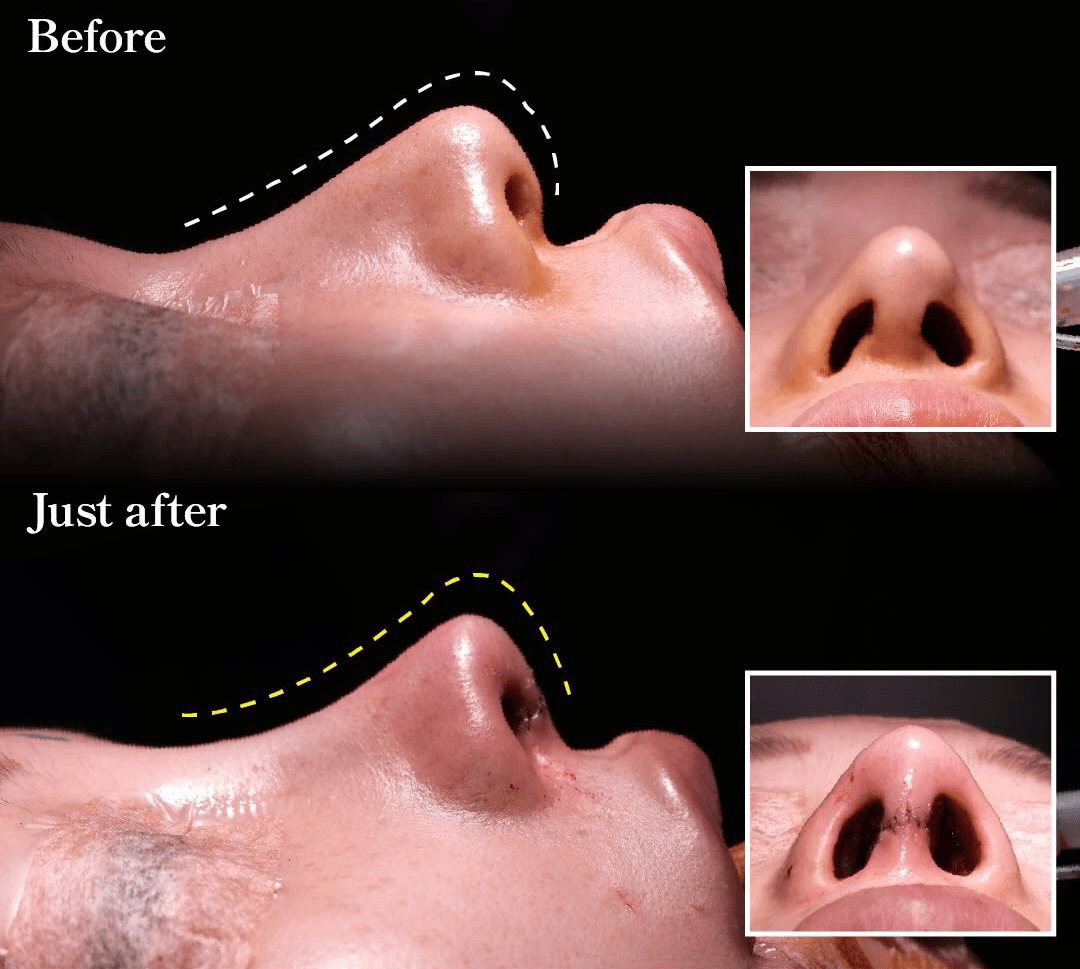
1. Rebuilding the Deviated Nasal Framework with Costal Cartilage
To correct the deviation of the underlying framework—the root cause of the crooked nose—we shaped costal cartilage and reconstructed a **straight, stable central support structure (L-strut)**.
This realigns the axis of the entire nose and facilitates improvement in asymmetry.
2. Creating a Natural Curve at the Nasal Tip
Rather than simply extending the nasal tip in a straight line, we created a contour with a soft C-shaped curve.
This curve helps create:
- An elegant, feminine nose
- A more attractive side profile
- A soft and natural appearance at the nasal tip
These aesthetic qualities can be achieved through this contour.
3. Refining the Nasolabial Angle for a More Attractive Side Profile
Even when the contour from the columella to the nasal tip and dorsum is well balanced,
a narrow nasolabial angle (the angle between the nose and upper lip)
can make the overall face appear heavier and the nose look shorter.
By adjusting this angle through septal extension,
the nasal tip appears naturally elevated, and the E-line becomes more balanced.
These improvements contribute to a more harmonious side profile.
4. Correction of a Pinched Nose
When viewed from the front, deep grooves were visible beside the nasal tip, creating a “pinched nose” appearance.
This can be caused by:
- Insufficient support of the lateral crura
- Excessive scarring
- Internal structures that are too short
These were among the contributing factors.
Auricular cartilage was grafted into the appropriate position to restore support to the collapsed areas and create natural roundness and volume.
5. Improvement of Breathing Function
In addition to improving the appearance of the nose, we performed procedures to:
- Widen the nasal airway
- Correct the deviated septum
- Reduce inward collapse of the nasal alae during inhalation
These procedures also improved the patient’s nasal breathing.
Before and After Complex Revision Rhinoplasty, Septal Extension Using Costal Cartilage, Tip Plasty, Auricular Cartilage Grafting, and Autologous Tissue Augmentation
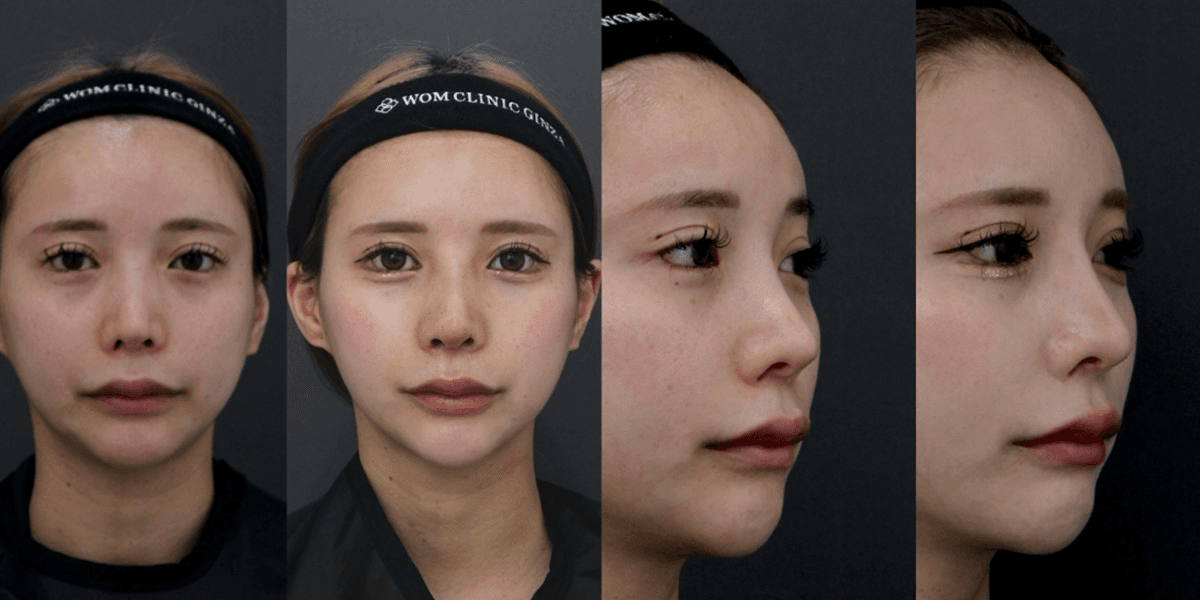
Postoperative Changes (Front View)
- Improved nostril symmetry
- Correction of the pinched nose
- Enhanced columellar definition, creating natural contours and shadows
- A straighter overall appearance of the nose
Postoperative Changes (Oblique View)
- A naturally defined and attractive C-shaped curve
- Improved height and smoothness of the nasal bridge
- A more harmonious transition from the nasal tip to the lips
Postoperative Changes (Side View)
- A refined nasolabial angle for a more elegant side profile
- An improved E-line and better balance with the mouth and lips
- A natural nasal tip height and angle, creating a more refined appearance
Before and After Complex Revision Rhinoplasty, Septal Extension Using Costal Cartilage, Tip Plasty, Auricular Cartilage Grafting, and Autologous Tissue Augmentation
Why Revision Surgery Is Challenging
Revision rhinoplasty is often assumed to be easier than the initial surgery, but the opposite is actually true.
Challenges of Revision Surgery
- Internal tissues have become hardened by scarring
- Cartilage used in previous surgery has become deformed
- Only a limited amount of cartilage remains
- The nasal septum is significantly deviated
- The skin is firm and has limited elasticity
- Blood circulation has been compromised
- Breathing function has deteriorated
As such, revision cases involve multiple interconnected issues rather than a single problem.
Therefore, achieving a satisfactory result requires:
Technique × Design × Experience
All three of these elements are essential for achieving a satisfactory outcome.
Because revision surgery accounts for a significant proportion of the procedures I perform,
I continuously study the latest techniques both in Japan and abroad,
exchange knowledge with renowned surgeons from around the world,
and continually refine my approach to provide better treatment options.
Summary
In this case, we were able to:
- Reconstruct the deviated nasal framework using costal cartilage
- Improve nostril asymmetry
- Correct the pinched nose to create a more natural shape
- Create a C-shaped curve at the nasal tip
- Refine the nasolabial angle and improve the side profile
- Improve nasal breathing
Through these procedures, we were able to improve both the form and function of the nose simultaneously.
The nose is located at the center of the face, and even a subtle difference can significantly change a person’s overall appearance.
That is why the ability to accurately design both the patient’s desired shape and a shape that complements their individual features is essential.
Even if another clinic has declined to treat your case or you are unsure how your concerns can be corrected,
please feel free to consult with us.
Patient-Provided Personal Photos Before and After Complex Revision Rhinoplasty, Septal Extension Using Costal Cartilage, Tip Plasty, Auricular Cartilage Grafting, and Autologous Tissue Augmentation